14 days. Daily HRV monitoring. Calibrated vagal protocols. Average HRV improvement: 28%. Average parasympathetic-dominant hours: 41% of cohort time, up from 19%.
Fourteen days of HRV-guided protocols at a clinical longevity hotel in Bali. Designed for high-performers whose autonomic balance has been sympathetic-dominant for years and won’t shift in a weekend retreat.

Who this is for
You measure your HRV. It hasn’t moved in eighteen months.
You’ve tried breathwork, cold plunges, somatic sessions. They help for a day, not a year.
You can feel the sympathetic dominance — the wired-tired pattern — and you’re done living inside it.
If three of these are true, this program is built for you.
The measurement
Most “nervous system reset” content stops at metaphor. Polyvagal this, vagus nerve that. We start where the metaphor ends — with the markers that show whether your autonomic nervous system is actually rebalancing, or whether you’re just relaxed for a weekend. These are the readings that follow you home, every quarter, for the first year.
HRV (continuous, 24h baseline + daily)
The single most reliable marker of parasympathetic capacity.
Baroreflex sensitivity
How responsive your cardiovascular reflexes are. Drops with chronic stress.
Resting heart rate + RHR variability
Trend signal of cardiac autonomic balance.
Salivary cortisol (4-point)
The HPA-axis side of the autonomic equation.
Sleep architecture (EEG / wearable)
Deep + REM consolidation requires parasympathetic dominance.
Respiration rate + breath-coherence patterns
Sympathetic breathing is shallow and irregular. Coherence is trainable.
hs-CRP, IL-6
Inflammatory tone. Chronically elevated under sympathetic dominance.
Skin conductance (sweat-response variability)
A direct readout of sympathetic activity.
Thyroid panel (TSH, fT3, fT4, rT3)
Thyroid downshifts under chronic stress. The autonomic-endocrine link.
Sleep onset latency + nighttime HR profile
How long it takes your nervous system to disengage. The most under-measured marker.
All bloodwork and wearable data is collected in advance of arrival. Results are interpreted by our clinical team and reviewed by our medical advisor before your first day on property. You arrive with the protocol already calibrated to your autonomic baseline.
The protocol
Burnout protocols are recovery-shaped. Nervous-system reset is rebalancing-shaped — we don’t just bring the sympathetic side down, we rebuild the parasympathetic capacity that’s atrophied from years of pushing. The arc reflects that: first we map where you are, then we recalibrate, then we anchor the new pattern so it travels home.
Days 1–4
Continuous HRV monitoring. Baseline autonomic profile. Sleep architecture mapped. Cortisol curve plotted. We see where the imbalance lives before we touch it.
Days 5–10
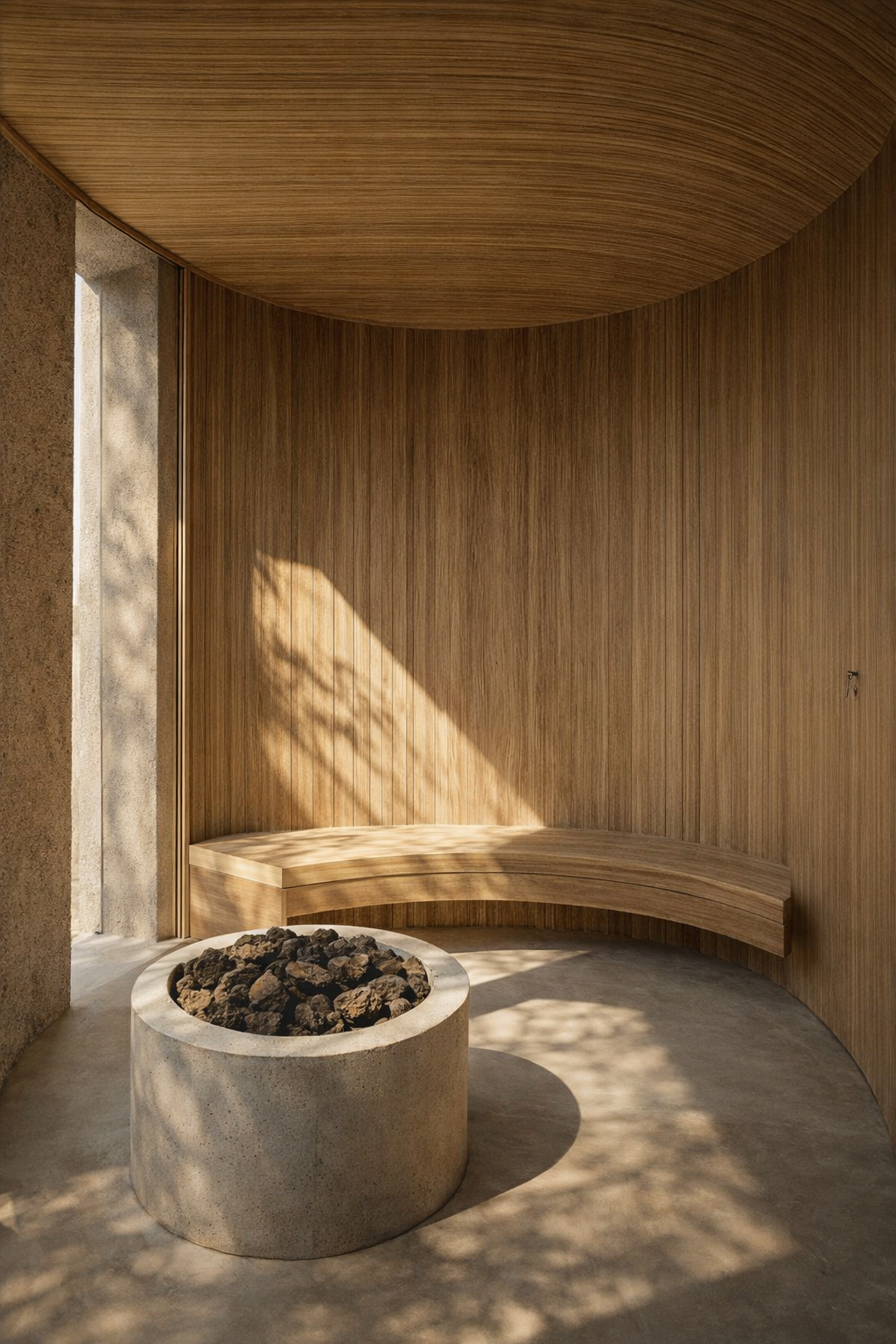
HRV-guided breath protocols (coherence + extended exhale). Cold dosed to HRV recovery, not maximum. Sauna timed to vagal response. Daily somatic sessions. NAD+ or vitamin C IVs dosed to autonomic status.
Days 11–14
You start integrating the take-home protocol. Daily HRV-target practice. The home plan calibrated to your baseline + your delta. Quarterly re-test scheduled.
A day at KINS — the daily rhythm
Expected outcomes
You will not be “regulated” forever in fourteen days. You will leave with a measurably more capable parasympathetic system, a calibrated daily practice that reinforces it, and quarterly re-tests for the first year so the gains compound instead of decay.
What measurably changes
What we won’t promise
The nervous system relearns slowly. Fourteen days at KINS is the inflection point. The first year of quarterly re-tests is where the rebalance compounds. We follow the data for at least twelve months.
The founder
I’m Cathy. My nervous system was stuck on for fifteen years.
Then one TruDiagnostic panel told the story the standard physical kept missing — kynurenine in the bottom 1% (the chronic-stress biomarker), white blood cells in the bottom 1%, hormone system aging 8.7 years faster than chronological. Sympathetic dominance, suppressed HRV, mitochondrial function at the 26th percentile. The systems that get hit by chronic high-performance stress were exactly the ones most damaged. I tried every modality. Most was expensive water. The ones that moved my autonomic markers are what KINS is built around.
If you’re a high-performer who plans to do this for the next thirty years, you can’t afford to figure it out after your nervous system gives out. That’s why this program exists.
Read the full story →Frequently asked
Both. The protocol is medical — real bloodwork, real HRV monitoring, real clinical supervision. The setting is a hotel. We call it a clinical longevity hotel because that’s what it is.
Pricing is shared during the application process. The program is all-inclusive of bloodwork, IV protocols, HBOT, daily HRV monitoring, all meals, accommodation, and post-program follow-up.
Somatic retreats and polyvagal workshops do important work — we use somatic practitioners ourselves. The difference is measurement and longitudinal follow-up. Most “nervous system” experiences end on the last day with a felt sense of regulation. We end on day 14 with calibrated HRV deltas, a home protocol, and quarterly re-tests for the first year. The fortnight is the start of the data record, not the conclusion.
That’s the starting baseline, not a disqualifier. Our medical advisor reviews every applicant’s wearable data before acceptance. Some of the most-improved cohort members started with the lowest baselines. What matters is the trajectory we can build across 14 days and the year that follows.
No. Breath protocols are dosed by HRV response, not by schedule. Most days include one supervised breath block (8–12 minutes) and one short vagal sequence. The remaining time is your protocol — HBOT, IV, somatic, walks, surf, sauna — with breathwork as a tool, not a center.
That’s information, not a disqualifier. Our medical advisor reviews every applicant’s panel and wearable data before acceptance. If your situation requires acute medical care, we’ll tell you that directly and recommend the right setting.
We don’t segment by gender or job title. The cohort is curated by physiological profile and stage of burnout, not demographics. Our medical advisor reviews every application.
Quarterly biomarker re-tests for the first year, included. A 90-day home protocol calibrated to your data. A monthly Cathy letter to the cohort. And first access to subsequent program cycles.
Get started